
A guide to asbestos in your home
Asbestos was used widely in Australian home construction until bans came in from the mid-1980s, with a full ban at the end of 2003. A lot of it is still in place today — the Asbestos Safety and Eradication Agency estimates roughly one in three Australian homes still contains it. If your home was built or renovated before 1990, it's worth understanding where asbestos can be, and how to deal with it safely.
Why older homes are the ones to watch
Asbestos was cheap, strong, fire-resistant and a good insulator, so it went into a huge range of building products — especially asbestos-cement sheeting (“fibro”). If your house was built or renovated before 1990, there’s a good chance some form of asbestos is still in it.
The important thing to understand: undisturbed, intact asbestos in good condition generally isn’t an immediate danger. The risk comes when the material is damaged, weathered, cut, drilled or broken — that’s when fibres can be released into the air and inhaled.
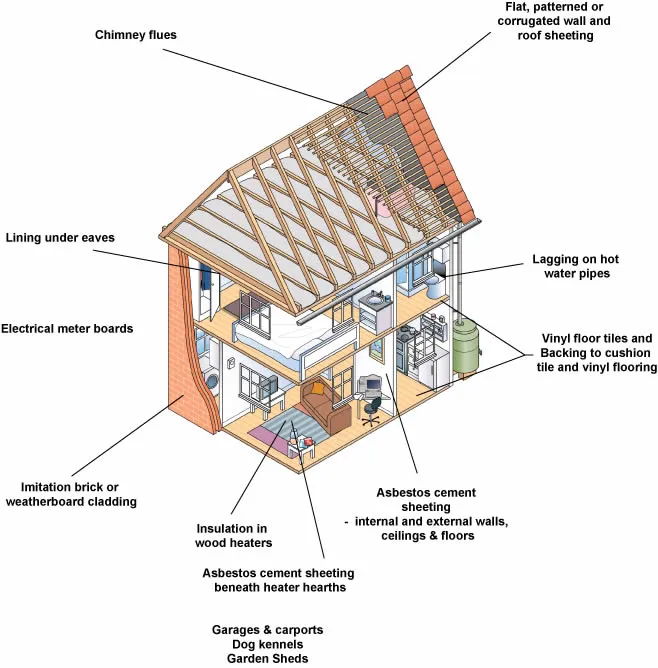
Where it hides inside
In older homes, asbestos commonly turns up in:
- Wet areas — bathrooms, toilets and laundries, in wall and floor sheeting and behind wall tiles.
- Kitchens — splashbacks, vinyl floor tiles, and the backing under vinyl sheet flooring (the backing is often friable).
- Walls and ceilings — fibro sheeting and cement-sheet cladding.
- Flooring — under lino and vinyl, and as underlay sheeting beneath ceramic tiles.
- Insulation and heating — lagging around old hot-water pipes, and in some old heaters and stoves. Loose-fill ceiling insulation was an issue in parts of the ACT and NSW (1968–1979).
- Around wiring — behind meter boards and switchboards.
Where it hides outside
- Roofing — roof sheeting, ridge capping, guttering and imitation-brick cladding.
- Eaves and external cladding.
- Fencing — cement-sheet fences.
- Sheds and carports — backyard fibro structures.
- Pipes — flue pipes, downpipes and some drainage.
It can even have been dumped or buried in the yard at some point.
What to do if you think you have it
You cannot tell whether a material contains asbestos just by looking — it has to be tested. So:
- Don’t disturb it. No sanding, cutting, drilling, water-blasting or breaking suspect material.
- Get it tested. Either send a safely collected sample for testing, or — if you’re not sure how to sample safely — book a property inspection and we’ll sample it for you. Our mobile unit can screen suspect materials on-site for a fast result.
- Decide with the facts. If asbestos is confirmed, the options are leave-and-monitor (if it’s sound and won’t be disturbed), seal/encapsulate, or licensed removal — depending on its type, condition and location.
If you’ve been renovating and disturbed something
Don’t panic. No amount of asbestos exposure is officially “safe”, but a single short exposure rarely causes disease — the serious risk is from repeated or heavy exposure. Stop work, keep people away from the area, and don’t sweep up dust. If you think you’ve disturbed it, shower, wash the clothes you were wearing separately, and get the material tested before doing anything else.
Still not sure? Just ask.
Call 1300 019 657, 7 days a week, or book an inspection and we'll give you a clear answer.